
Making of the Short * Interesting Facts * Interviews with the Crew
Making of the Short * Interesting Facts * Interviews with the Crew
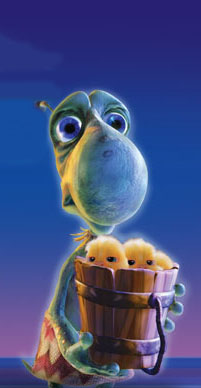 Directed
by: Eric Armstrong (rumored)
Directed
by: Eric Armstrong (rumored)
When Sony Pictures Imageworks revealed plans in 2001 to throw its hat into the feature animation ring, industryites questioned whether the f/x facility behind Spider-Man would be able to compete artistically with the likes of Pixar Animation Studios, Blue Sky Studios or DreamWorks/PDI. But the company surprised critics and audiences at Men in Black II in July 2002 with The ChubbChubbs, a 5-1/2-minute all-CG short bowing in front of the sci-fi sequel and featuring Meeper, who tries to save the otherworldly patrons of the Ale-E-Inn from impending danger.
"We never intended for this to be released," admitted Tim Sarnoff, CEO of Sony Pictures Imageworks, in July 2002. "It was more to see if our system works. But when we finished, we thought, now what are we going to do with it?" Directed by Eric Armstrong, the animation supervisor for both Stuart Littles, ChubbChubbs was chosen in December as the first project to move through Imageworks' all-CG feature animation production pipeline. "The whole intent was to set something that would allow us to pull people off of one project and put them onto another really quickly, without disrupting the production process," Sarnoff says. "We needed something that would let us test whether we could work on an animated film and create f/x for live-action films at the same time."
The designs for the short film were created in January 2002, with production
beginning in late February. More than 2,500 animators ended up working
on the short, bouncing over from Spider-Man and Stuart Little
2 once shots on the live-action pictures were completed. ChubbChubbs
was finished and shown to Sony brass in June 2002. It generated enough
positive responses from distribution and exhibition executives at the studio
to find it a home on roughly 3,000 theatrical prints of MIB II.
It was also screened in front of Stuart Little 2, which opens July
19. "It's been very fun to hear from people today, since we really didn't
announce the film," said a Sony Pictures Imageworks rep in July 2002. "We
kind of let people discover it."
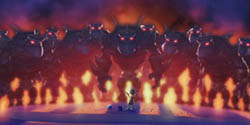
 Tim Sarnoff,
president of Sony Pictures Imageworks, commented in February 2003 that
"we have a long-range plan in the company that started five years ago to
become a character animation facility. Our effort has been directed primarily
to do photo-realistic live-action movies. So we set up a pipeline that
made sure we would be able to create a fully stylized CG project while
at the same time continuing to do the photo-realistic visual effects business.
ChubbChubbs
was the vehicle where we were able to create a new pipeline." Imageworks,
says Sarnoff, began working on ChubbChubbs in September 2001 "as
a 'Gong Show' for all the individuals in the company to pitch a project."
By December, they had narrowed the pitches to a dozen, which was further
winnowed down to three. Eventually, Jeff Wolverton's idea, Attack of
the ChubbChubbs, was picked and Eric Armstrong was chosen to direct.
A team of 100 artists and technicians worked on the film. "We started animating
it in February and finished the project in May. The intent was to put as
much animation through our facility in that style as we possibly could.
Mostly, they were story people. We had the animators here and we have the
technical expertise already created, but what we learned from this is how
to edit ourselves. It's not so easy to make a six-minute short. This could
have been a two-hour short." After ChubbChubbs was finished, Imageworks
screened it for the motion picture group at Sony. The enthusiastic executives
then screened it for the exhibitors, who were equally enchanted with the
comedy. By July, ChubbChubbs was paired with Men in Black II on
more than 3,000 screens. It's also featured on the MIB II DVD and
was released as a stand-alone DVD on April 11, 2003 for the retail price
of $9.95.
Tim Sarnoff,
president of Sony Pictures Imageworks, commented in February 2003 that
"we have a long-range plan in the company that started five years ago to
become a character animation facility. Our effort has been directed primarily
to do photo-realistic live-action movies. So we set up a pipeline that
made sure we would be able to create a fully stylized CG project while
at the same time continuing to do the photo-realistic visual effects business.
ChubbChubbs
was the vehicle where we were able to create a new pipeline." Imageworks,
says Sarnoff, began working on ChubbChubbs in September 2001 "as
a 'Gong Show' for all the individuals in the company to pitch a project."
By December, they had narrowed the pitches to a dozen, which was further
winnowed down to three. Eventually, Jeff Wolverton's idea, Attack of
the ChubbChubbs, was picked and Eric Armstrong was chosen to direct.
A team of 100 artists and technicians worked on the film. "We started animating
it in February and finished the project in May. The intent was to put as
much animation through our facility in that style as we possibly could.
Mostly, they were story people. We had the animators here and we have the
technical expertise already created, but what we learned from this is how
to edit ourselves. It's not so easy to make a six-minute short. This could
have been a two-hour short." After ChubbChubbs was finished, Imageworks
screened it for the motion picture group at Sony. The enthusiastic executives
then screened it for the exhibitors, who were equally enchanted with the
comedy. By July, ChubbChubbs was paired with Men in Black II on
more than 3,000 screens. It's also featured on the MIB II DVD and
was released as a stand-alone DVD on April 11, 2003 for the retail price
of $9.95.
The ChubbChubbs
won several major animation awards before winning the Oscar for Best Animated
Short, beating Pixar's Mike's New Car. "It tells a story of universal
truth," said Tim Sarnoff. "It's an Everyman story. We are thrilled that
people have responded well. It allows us to develop our talent"
Right after receiving
the Oscar for Best Animated Short, director Eric Armstrong told the press
in March 2003 that "it was sort of a little test, just to see what was
working, what wasn't, and if we were prepared to do a feature basically.
And, of course, I'm kind of glad we did it now. Whether or not there is
a feature, I think the success has created some interest in that possiblity.
There are more animation shorts being made, Pixar and Disney are now creating
shorts. A lot of companies are doing them now, so hopefully they're coming
back."
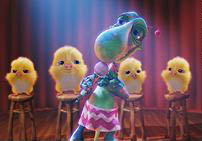 Sony Imageworks
said it hoped to start is first full-length CG feature--not a ChubbChubbs
story--for Sony Pictures Animation sometime in 2003. "There's a desire
from the audience to see more shorts that make them laugh rather than sell
them popcorn," says Tim Sarnoff, who grew up watching Looney Tunes cartoons
at the movies. "But to come up with a vehicle to tell a story in six minutes,
I don't know if there is an economic mechanism yet to make it viable for
[movie] companies to do this as a business."
Sony Imageworks
said it hoped to start is first full-length CG feature--not a ChubbChubbs
story--for Sony Pictures Animation sometime in 2003. "There's a desire
from the audience to see more shorts that make them laugh rather than sell
them popcorn," says Tim Sarnoff, who grew up watching Looney Tunes cartoons
at the movies. "But to come up with a vehicle to tell a story in six minutes,
I don't know if there is an economic mechanism yet to make it viable for
[movie] companies to do this as a business."
However, director Eric
Armstrong admitted on March 30, 2003 that Sony Pictures Imageworks' The
ChubbChubbs! might be indeed headed for the big screen soon. "It just
won an Academy Award, so everyone's thinking there's definitely something
in there," says director Eric Armstrong. "The idea was always that we could
recoup the investment by making it into a feature."
Sony Pictures
Animation, headed by DreamWorks alumnae Sandra Rabins and Penney Finkelman
Cox, announced officially in May 2003 that it was developing a feature-length
version of Sony Pictures Imageworks' Academy Award-winning short film The
ChubbChubbs!. "Our goal was to find unique voices that had stories
to tell. We're not trying to brand Sony animation as revolving around one
type of storyteller or one type of story, and we don't want to develop
just one look which all our films share. Our hope is that each movie will
be very unique. It's important to us that we keep the notion that we are
working for a very broad audience, something that every member of a family
can enjoy. That was a very rewarding process for us when we worked on Shrek,
and we'd like to have the same kind of results. We want to create films
that are attractive to a wide audience. That's our hope and our ambition.
We are trying to be an open shop, open to new ideas and talent from outside
the company--as opposed to places like Disney and Nickelodeon, which tend
to be very closed."
The six-minute
short "made people laugh, and it had a whole world of characters," says
Tim Sarnoff, Imageworks president. "Now we have to place Meeper into an
environment where there's more than just Meeper to identify with. That
could take years."
An insider reported
on August 19, 2003 that Sony was in negotiation with Queen Latifah, Jimmy
Fallon and Mark Wahlberg to voice respectively the singing diva, Meeper
and Boris, Meeper's bouncer cousin. On a much less reliable note, Jerry
Stiller was supposedly being considered for the role of Meeper's father,
while Jamie Lee Curtis might voice Meeper's mom and Sarah Silverman Meeper's
attractive sister; Matthew McConaughey is rumored to voice as an alien
cattle rancher, Reba McEntire his wife and Dakota Fanning their daughter;
Jon Lovitz was mentioned as an alien taxi driver, and Arnold Schwarzennager
as the villain (highly unlikely at this point!); and last but not least,
Mexico's George Lopez, Italy's Asia Argento, France's Olivier Martinez
and U.K.'s Mark Addy all playing astronauts from the native countries (with
an uncast American astronaut as well).
Leonard Teo and Tito A. Belgrave
went behind the scenes with Sony Pictures Imageworks on the making of the
debut short The ChubbChubbs on this January 6, 2003 special at CGNetworks.
CGNetworks: What challenges did your team face throughout the making of The ChubbChubbs?
 Eric
Armstrong: The ChubbChubbs presented a unique set of challenges,
both creative and technical, throughout its development period. One of
the biggest hurdles that faced the team was the sheer visual scope of the
project. But when it came to creating the many inhabitants of the planet
Glorf, it ultimately proved to be a lot of fun for the filmmakers.
Eric
Armstrong: The ChubbChubbs presented a unique set of challenges,
both creative and technical, throughout its development period. One of
the biggest hurdles that faced the team was the sheer visual scope of the
project. But when it came to creating the many inhabitants of the planet
Glorf, it ultimately proved to be a lot of fun for the filmmakers.
CGNetworks: The ChubbChubbs had a very large cast of characters?
Eric Armstrong: It's really an epic short--it was quite an experience
to create over forty characters that had to be modeled in order to populate
the Ale-E-Inn. With all the characters and visuals coming at you in such
a short amount of time, we had to make sure that our hero, Meeper, stood
out both visually and emotionally. Brad Simonsen was able to achieve the
perfect nasal voice with just enough innocence to balance out Meeper's
character.
CGNetworks: With the 40+ characters in the ChubbChubbs, and the production time allotted to you, how was animation finished efficiently and on time?
Eric Armstrong: Since the cast of The ChubbChubbs was
so vast, we used short cuts throughout the film technically, but always
stayed true to the story. All the characters in the bar were keyframed
manually. Although the rigging process wasn't complex, binding the characters
turned out to be since we also had to use some stock animation cycles for
characters further away from the camera. On and off we had at least 25-30
animators at a time throughout the short, we would basically pull animators
who weren't creating any shots for Spider-Man and Stuart Little,
which were also being produced at the same time.
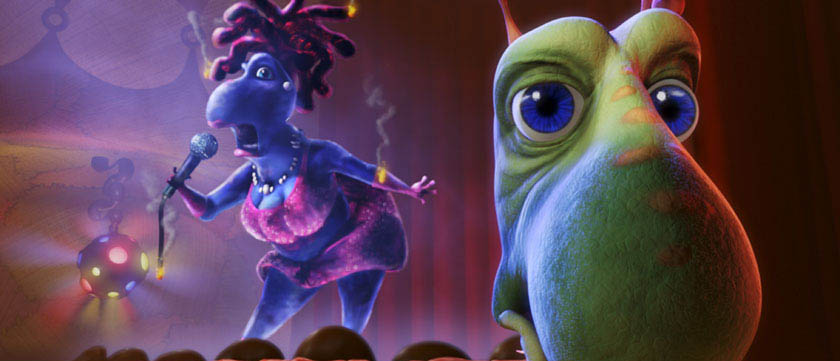 CGNetworks:
The Diva was another memorable character, and she seemed to be the foil
for the comical aspect of the short.
CGNetworks:
The Diva was another memorable character, and she seemed to be the foil
for the comical aspect of the short.
Eric Armstrong: Yes that's correct, she was most definitely used
as the foil or comic relief for Meeper's clumsiness. Diva is a bigger than
life character, ultimately, Yarrow Cheney incorporated a hybrid of traits
from many inspirational references for the final version. She had a combination
Ethel Merman for her physicality and vocal prowess and a wardrobe of Britney
Spears, which would give you our Diva.
CGNetworks: What methods were used for modeling the characters? Was it all NURBS-based or were Sub-Division techniques?
Eric Armstrong: Actually we used NURBS characters as most of
the staff that worked on The ChubbChubbs were already quite familiar with
using NURBS in the production pipeline. Since time constraints were already
tight we opted for what we already know, though we haven't ruled out Sub-Division
techniques completely as they will be used more in the future.
CGNetworks: How was the ChubbChubbs' fur handled, was it in the same
fashion as Stuart Little's?
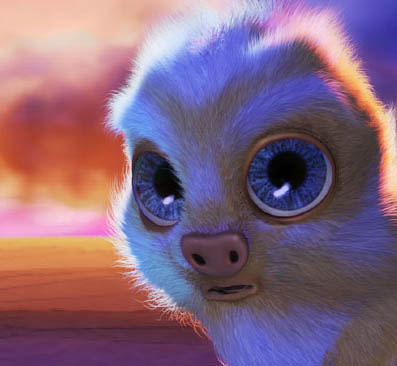
Eric Armstrong: The fur on the ChubbChubbs was quite similar
to Stuart’s but not as complex, we didn't have the timeframe we had with
Stuart to manually hand tweak it at every interval, so we used some shortcuts
to speed up render time while retaining good visually quality.
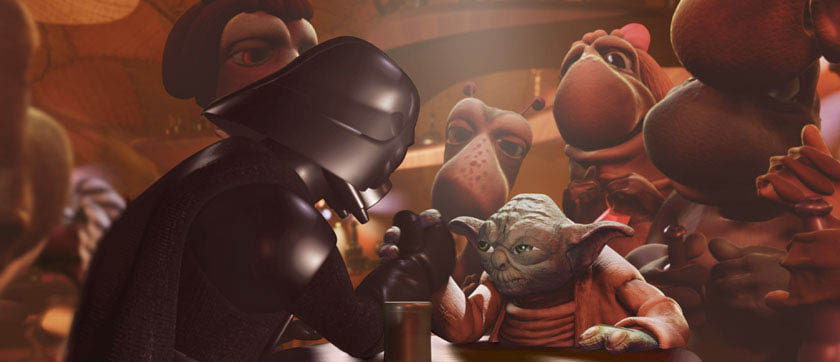
CGNetworks: I noticed there was quite a number of Star Wars cameos from certain memorable characters.
Eric Armstrong:Yes there was quite a few of them, Darth Vader,
Jar Jar even! What we were trying to portray was that the watering hole
(Ale–E-Inn) was where all the popular locals would go to relax. It also
added essence to the bar, since they were used for gags.
CGNetworks: Can we expect to see anymore of The ChubbChubbs?
Eric Armstrong: At this point [in late 2002] I can safely say
there's no future plans to continue work on The ChubbChubbs. The
short was basically an in-house production test to give us an idea on how
a project of this spectrum would be on a smaller scale. Also we believe
that the story was told in the time given for the short, but we also know
other developments can come from some of the existing characters such as
Diva and Boris. I wouldn't totally rule it out, you never know, but in
that respect, although I'm not currently assigned to any at the moment,
we're definitely heading in the direction of full feature animated films.
VFX PRODUCER JACQUIE BARNBROOK
CGNetworks: How did the personality of the main character Meeper came to be?
 Jacquie
Barnbrook: We knew we wanted Meeper to come across a little timid,
sort of an everyman Walter Mitty type. Once the character design evolved,
the team then set out to his refine his voice. We had to look no further
than production coordinator Brad Simonsen.
Jacquie
Barnbrook: We knew we wanted Meeper to come across a little timid,
sort of an everyman Walter Mitty type. Once the character design evolved,
the team then set out to his refine his voice. We had to look no further
than production coordinator Brad Simonsen.
CGNetworks: What length of time did the production take to complete?
Jacquie Barnbrook: We began storyboarding at the end of September
2001 right through to December, but the main core of the film was produced
from March to May 2002.
Tito A. Belgrave: Can you elaborate on the choice of music used in The ChubbChubbs? There were quite a few golden oldies.
Jacquie Barnbrook: Chance Thomas led the way in the musical department
of The ChubbChubbs. Amazingly enough he recreated and recorded all
the original music that was used throughout the short. We had so many different
types of music to choose from, but the choices were finally narrowed down
to 10. We knew we wanted the music to really help carry the story and we
required it to create a sense of emotion in regards to Meeper, basically
further pushing the message "you can’t judge a book by its cover." In fact
the animation was done according the music chosen. Professional singers
were also brought in for the Diva. Even a new band was hired to help re-created
the original music.
CGNetworks: I noticed a lot of shortcuts were used throughout the short, things such as lack of details in certain areas. This no doubt was due to time constraints?
Jacquie Barnbrook: Yes definitely, time was the major obstacle
we had to overcome, and in regards to that we had to cut corners to save
time and money, but we didn't want to lose the essence of the story, so
if a character or an object that was in the forefront that help tell the
story, this is what they concentrated on. Things such as the lack of bump
maps on the bucket weren't of the utmost importance.
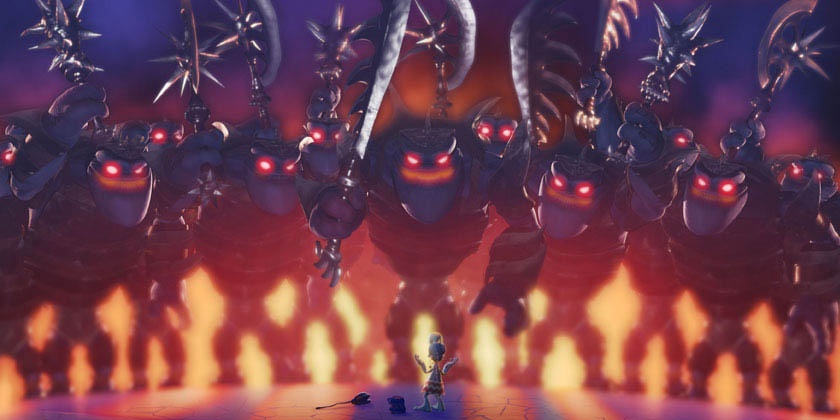
CGNetworks: When I first saw The ChubbChubbs for what they really were I was quite surprised to say the least, were children scared by them?
Jacquie Barnbrook: Quite honestly no, we brought in children
ranging from 4-12 years of age to view the film, and believe it or not,
not one of them thought the ChubbChubbs were scary. I guess it's due to
the fact that the ChubbChubbs only become fierce predators when threatened,
they didn’t feel threatened by Meeper because of his kindness and caring
ways, and the fact that he tries to save them.
CGNetworks: Were they any problems with using Star Wars characters in the short?
Jacquie Barnbrook: Actually not at all! We showed George Lucas
the short and he thought it was quite funny and very good. So getting an
OK wasn't too difficult after that.
TIM SARNOFF, PRESIDENT OF SONY PICTURES IMAGEWORKS
CGNetworks: Is there a market for feature animations?
 Tim
Sarnoff: Of course! There's a market for good stories no matter what
process those stories are told - whether it be through live action or through
animation. Imageworks has been around for ten years and in the last five,
we have endeavored to create characters such as Stuart Little, Spider-Man,
etc. As a result, we have developed a very strong pipeline to create photo-realistic
digital characters--believable characters for the audience. What we have
accomplished in photo-realistic live action characters, we also wanted
to tackle in full CG animations. So we created a small effort to create
our own shorts, which is how The ChubbChubbs came to be. The intent
for ChubbChubbs was not for distribution, but for creating a story
within the company and then fulfilling all the obligations necessary to
work on an animation project while maintaining our other core business
creating visual effects. We are working with Sony Pictures Animation to
set up their first project. The genesis of Sony Pictures Animation was
essentially an extension of Sony Pictures Imageworks' ability to create
digital characters.
Tim
Sarnoff: Of course! There's a market for good stories no matter what
process those stories are told - whether it be through live action or through
animation. Imageworks has been around for ten years and in the last five,
we have endeavored to create characters such as Stuart Little, Spider-Man,
etc. As a result, we have developed a very strong pipeline to create photo-realistic
digital characters--believable characters for the audience. What we have
accomplished in photo-realistic live action characters, we also wanted
to tackle in full CG animations. So we created a small effort to create
our own shorts, which is how The ChubbChubbs came to be. The intent
for ChubbChubbs was not for distribution, but for creating a story
within the company and then fulfilling all the obligations necessary to
work on an animation project while maintaining our other core business
creating visual effects. We are working with Sony Pictures Animation to
set up their first project. The genesis of Sony Pictures Animation was
essentially an extension of Sony Pictures Imageworks' ability to create
digital characters.
CGNetworks: How did The ChubbChubbs come about? As mentioned before, the intent was to create a story within Imageworks, but was it also to test the current pipeline and see if it could extend itself to full-CG animations?
Tim Sarnoff: Correct, we started The ChubbChubbs as a
small project within the company to test all the capabilities within the
pipeline structure--not necessarily just the technical ones but the storytelling
and animation too. We also wanted to see if this CG project would interfere
with our other businesses, which it did not. We were able to produce all
of The ChubbChubbs on schedule while maintaining all the other projects
in the pipeline. When we finished The ChubbChubbs, it was our intention
to show it to the Motion Picture Group at Sony, to say "look we're now
able to create a CG project and are able to create a feature-length CG
animation." From beginning to end, we did The ChubbChubbs in four months,
it was a very fast project. We were surprised and thrilled by the
reaction of the Motion Picture Group, who wanted to have the short distributed
along with one of the feature films going out--they chose to show it with
Men
in Black II. It's nice to see The ChubbChubbs being recognized by various
festivals around the world such as 3D Festival, because it now has more
value than simply being a technical test. This is a story that has characters,
has bewildered the audience about why we're all here.
CGNetworks: Along the way, what sort of pipeline issues or challenges did Imageworks come across?
Tim Sarnoff: It's interesting--one of the hardest thing to do
is to edit something that you like out of the film. The story had to be
told in six minutes, but there were enough ideas to make the story as much
as three times as long! I think the hardest lessons learned by the animators
was watching their shots on the cutting room floor. The hardest process
for the group was to be able to make sure it was telling the story from
beginning to end without getting side-tracked by the jokes! You'd be surprised,
when you work on a story for a number of months, it's easy to forget that
you're telling a story rather than, "here's the joke."
CGNetworks: What sort of challenges is Imageworks expecting to face going about the full feature animation route? Considering that Imageworks is (sort of) a newcomer compared to Pixar and PDI?
Tim Sarnoff: I think the risk for this company will always rest
of the shoulders of those who tell the story - not in the actual production
process itself. We're not necessarily a newcomer in creating the product,
we've been doing it for a decade and we are large enough to be able to
manage a full CGI film while maintaining our core business of visual effects.
We're not changing our strategy by going from one business to another,
we're simply adding this to our existing business.
|
||||||||||||

