 Directed
by: Glen Keane
Directed
by: Glen Keane
Written by: Adam and Melanie Wilson
Music by: Chris Curtis (rumored)
Directed
by: Glen Keane
Written by: Adam and Melanie Wilson
Music by: Chris Curtis (rumored)
Production Started on:
Release Date: 2007 at the earliest
 In 1998, Chris
Curtis (composer of the Chaplin musical) revealed that he was writing
songs for a Disney adaptation of Rapunzel. His involvement in the
project was confirmed in late September 2001.
In 1998, Chris
Curtis (composer of the Chaplin musical) revealed that he was writing
songs for a Disney adaptation of Rapunzel. His involvement in the
project was confirmed in late September 2001.
In July 2001,
sources at Disney confirmed that Rapunzel was in pre-production, with several
top animators including Glen Keane currently working on character concepts.
Producer Thomas Schumacher commented during an interview that "there's
another musical fairy tale in the works. Because, you know, every five
years or so, you need [laughs] - we've only made a handful of fairy tales,
actually, but there's another one that we haven't announced. It's
a fairy-tale title that you'll know."
But note that
the Brizzi Brothers, who have been developing unsuccessfully a dark adaptation
of Don Quixote for the Disney studio, then animators Dick Zondag
and Dave Goetz, have been working on another fairy tale: Hans Christian
Andersen's The
Snow Queen.
According to an
unofficial October 2001 report, Rapunzel is no longer in development
at the Mouse House.
This was denied
in May 2002, when the news broke that master animator Glen
Keane took advantage of The
Snow Queen being sent back to the story department to announce
that he was leaving the project. After decades of doing stellar work
on other people’s pictures, Keane had finally decided that he wants to
direct a feature of his very own. He is now trying to come with a feature
length story line for a film that's based on Rapunzel. Disney
studio execs were understandably upset when Keane upped and quit The
Snow Queen, a project extremely important to WDFA’s future since it
will be their first feature length cartoon based on a classic fairy tale
since the original Aladdin back in 1992.
Mouse House execs are really counting on this movie to help the Walt Disney
Company reconnect with its increasingly disenfranchised customers. So to
have a big gun like Glen opt not to work on that project anymo re (and
take a flyer on something as flaky as Rapunzel) was really a blow.
That said, Disney execs were still thrilled that Keane opted to stay at
WDFA.
A Disney insider
confirmed in July 2002 that Glen Keane was indeed doing conceptual artwork
for the project, which is supposedly going to be CG-animated.
Asked about his
follow-up project to Treasure Planet
during an online chat in November 2002, Glen Keane let slip that "usually
at this point of the film, there is another picture already in sight. After
Little
Mermaid, it was The Beast,
after Pocohontas is
Tarzan
and after Tarzan it was Silver. Now, the
fairytale is calling to me, that I'm considering directing."
In a December
2002 article, Entertainment Weekly
mentions that "in a corner of Glen Keane's office, there's a cascade of
bright yellow yarn, braided like hair, hanging from a bulletin board. It's
clearly a bit of inspiration for Rapunzel, a feature in development
at Disney that Keane would like to direct rather than merely animate. There's
talk the film could be an all-CG effort. No decisions yet." For the first
time in a decade, Keane has no assignment in demanding his immediate attention.
His current contract expires next summer. "We're at a crossroads," the
animator commented. "Disney is a very odd place to be these days... I'm
trying to take my future into my own hands, and figure out a way I can
be married to the computer and continue to draw." He's thinking Rapunzel
could show off a fusion of hand-drawn figures with computer-animated clothing
and hair--"as long as I can make the face."
Even though Rapunzel
had initially been envisioned as a mix of CG and traditional animation,
it is now reportedly being thought of as strictly computer animated film.
Disney's chief
of animation David Stainton roiled the ranks on April 28, 2003 when he
told a gathering of 525 animation employees that he wants them to produce
lush, classic fairy tales--The Snow Queen
and Rapunzel, according to the Los Angeles Times--entirely on computers.
His vision was greeted with dropped jaws by the roomful of artists steeped
in the traditional style of hand-drawn animation pioneered by Disney. "There's
a lot of fear," said veteran Disney animator Glen Keane, who drew the characters
Tarzan, Aladdin and Pocahontas. "He's trying to steer the studio in a direction
that half the artists are afraid to go and the other half are headlong
racing down that path." Keane said he felt "personally challenged." For
his part, Stainton said he was simply "throwing another grenade into the
pot." He knows that his message has "caused anxiety here because what I'm
asking doesn't currently exist -- and that frightens people."
Walt Disney Feature
Animation announced on April 30, 2003 via Variety that it intended to develop
Rapunzel
as an all-CGI production, and had hired brother and sister screenwriters
Adam and Melanie Wilsonto write the movie's script. The Wilsons both had
worked in Hollywood before making the leap to being paid screenwriters,
with Adam working in production at MTV and Melanie a former unit publicist.
Mouse
Planet's David Koenig reported in August 2003 that Disney wants to
wants to use "motion capture," the quasi-animated computer technique used
in the sci-fi bomb Final Fantasy: The Spirit Within, in Rapunzel.
'Mr Fun' stated
at Animation
Nation in September 2003 that "it's a go for Chicken
Little and Rapunzel." However, 'johnoops' states that "Rapunzel
may be ahead on the schedule but I predict it won't get made. Disney's
developers and Glen [Keane] are trying to invent a 'magical' computer technology
that will take Glen's drawings and turn them automatically into 3D animation.
This is clearly pie in the sky technology meant as a nice make work project
for Disney's developers. Kudos if they can ever get this fantasy app to
ever work, let alone work in a production environment, but I'm not holding
my breath. Years of expensive waste, and Rapunzel being shelved,
is my prediction." 'unionrep' corrects that "Mr. Keane will be directing
and doing story work on Rapunzel. He won't be animating." A lot
of rumors to chew on...
Disney chief of
feature animation David Stainton commented in September 2003 that "I noticed
that for an organization known for fairy tales, we hadn't done one since
Beauty
and the Beast. It's something that the audience wants and we can
uniquely present. What makes fairy tales significant are the very deep
themes that resonate through them and touch everybody."
USA Today revealed
in September 2003 that Rapunzel won't make her debut until at least
2007. Don't expect a serious bookworm like Beauty's
Belle or a passive victim like Snow
White, not after hoary fairy-tale traditions have been irreverently
and irrevocably Shrek-ified.
Rapunzel will be a tower-dwelling heroine who really lets her hair down.
"For the first time, we'll have a Disney princess who's a fully comedic
character," Stainton says.
"Usually we relegate the comedy to the sidekicks, but not anymore."
'Dunne' addressed
in October 2003 rumors at Animation
Nation that the Disney film would be animated in CGI
Mocap: "Glen and co. are attempting to do something very special. He's
talked about how very excited he is about the new technologies, and he's
determined to utilize them to do something NEW with his drawings. It's
not mocap, exactly (not like the new Zemeckis
film), but a hybrid of drawing and CG. To say the pencil is being yanked
from his hand because of CGI is just [incorrect]." 'biz rep' added that
"Mr. Keane had little choice in the matter. Mr. Keane was told by Eisner
and Stainton that the movie would be CGI, so CGI it will be. And Mr. Keane
is directing it because he has little interest in becoming a CGI animator.
In other words: no pencil work, no Glen Keane animation. Directing (and
story work) will now be his bag."
ONCE upon a time there lived a man and his wife who were very unhappy because they had no children. These good people had a little window at the back of their house, which looked into the most lovely garden, full of all manner of beautiful flowers and vegetables; but the garden was surrounded by a high wall, and no one dared to enter it, for it belonged to a witch of great power, who was feared by the whole world.
One day the woman stood at the window overlooking the garden, and saw there a bed full of the finest rampion: the leaves looked so fresh and green that she longed to eat them. The desire grew day by day, and just because she knew she couldn't possibly get any, she pined away and became quite pale and wretched. Then her husband grew alarmed and said:
"What ails you, dear wife?"
"Oh," she answered, "if I don't get some rampion to eat out of the garden behind the house, I know I shall die."
The man, who loved her dearly, thought to himself, "Come! rather than let your wife die you shall fetch her some rampion, no matter the cost." So at dusk he climbed over the wall into the witch's garden, and, hastily gathering a handful of rampion leaves, he returned with them to his wife. She made them into a salad, which tasted so good that her longing for the forbidden food was greater than ever. If she were to know any peace of mind, there was nothing for it but that her husband should climb over the garden wall again, and fetch her some more. So at dusk over he got, but when he reached the other side he drew back in terror, for there, standing before him, was the old witch.
"How dare you," she said, with a wrathful glance, "climb into my garden and steal my rampion like a common thief? You shall suffer for your foolhardiness."
"Oh!" he implored, "pardon my presumption; necessity alone drove me to the deed. My wife saw your rampion from her window, and conceived such a desire for it that she would certainly have died if her wish had not been gratified." Then the Witch's anger was a little appeased, and she said:
"If it's as you say, you may take as much rampion away with you as you like, but on one condition only -- that you give me the child your wife will shortly bring into the world. All shall go well with it, and I will look after it like a mother."
The man in his terror agreed to everything she asked, and as soon as the child was born the Witch appeared, and having given it the name of Rapunzel, which is the same as rampion, she carried it off with her.
Rapunzel was the most beautiful child under the sun. When she was twelve years old the Witch shut her up in a tower, in the middle of a great wood, and the tower had neither stairs nor doors, only high up at the very top a small window. When the old Witch wanted to get in she stood underneath and called out:
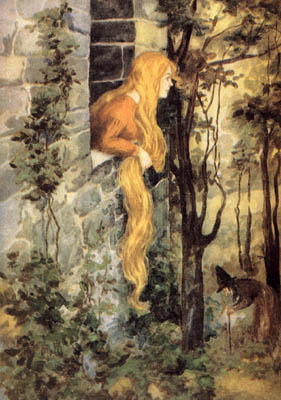 "Rapunzel,
Rapunzel,
"Rapunzel,
Rapunzel,
Let down your golden hair,"
for Rapunzel had wonderful long hair, and it was as fine as spun gold.
Whenever she heard the Witch's voice she unloosed her plaits, and let her
hair fall down out of the window about twenty yards below, and the old
Witch climbed up by it.
After they had lived like this for a few years, it happened one day that a Prince was riding through the wood and passed by the tower. As he drew near it he heard someone singing so sweetly that he stood still spell-bound, and listened. It was Rapunzel in her loneliness trying to while away the time by letting her sweet voice ring out into the wood. The Prince longed to see the owner of the voice, but he sought in vain for a door in the tower. He rode home, but he was so haunted by the song he had heard that he returned every day to the wood and listened. One day, when he was standing thus behind a tree, he saw the old Witch approach and heard her call out:
"Rapunzel, Rapunzel,
Let down your golden hair."
Then Rapunzel let down her plaits, and the Witch climbed up by them.
"So that's the staircase, is it?" said the Prince. "Then I too will climb it and try my luck."
So on the following day, at dusk, he went to the foot of the tower and cried:
"Rapunzel, Rapunzel,
Let down your golden hair,"
and as soon as she had let it down the Prince climbed up.
At first Rapunzel was terribly frightened when a man came in, for she had never seen one before; but the Prince spoke to her so kindly, and told her at once that his heart had been so touched by her singing, that he felt he should know no peace of mind till he had seen her. Very soon Rapunzel forgot her fear, and when he asked her to marry him she consented at once. "For," she thought, "he is young and handsome, and I'll certainly be happier with him than with the old Witch." So she put her hand in his and said:
"Yes, I will gladly go with you, only how am I to get down out of the tower? Every time you come to see me you must bring a skein of silk with you, and I will make a ladder of them, and when it is finished I will climb down by it, and you will take me away on your horse."
They arranged that till the ladder was ready, he was to come to her every evening, because the old woman was with her during the day. The old Witch, of course, knew nothing of what was going on, till one day Rapunzel, not thinking of what she was about, turned to the Witch and said:
"How is it, good mother, that you are so much harder to pull up than
the young Prince? He is always with me in a moment."
"Oh! you wicked child," cried the Witch. "What is this I hear? I thought
I had hidden you safely from the whole world, and in spite of it you have
managed to deceive me."
In her wrath she seized Rapunzel's beautiful hair, wound it round and round her left hand, and then grasping a pair of scissors in her right, snip snap, off it came, and the beautiful plaits lay on the ground. And, worse than this, she was so hard-hearted that she took Rapunzel to a lonely desert place, and there left her to live in loneliness and misery.
But on the evening of the day in which she had driven poor Rapunzel away, the Witch fastened the plaits on to a hook in the window, and when the Prince came and called out:
"Rapunzel, Rapunzel,
Let down your golden hair,"
she let them down, and the Prince climbed up as usual, but instead of his beloved Rapunzel he found the old Witch, who fixed her evil, glittering eyes on him, and cried mockingly:
"Ah, ah! you thought to find your lady love, but the pretty bird has flown and its song is dumb; the cat caught it, and will scratch out your eyes too. Rapunzel is lost to you for ever -- you will never see her more."
The Prince was beside himself with grief, and in his despair he jumped
right down from the tower, and, though he escaped with his life, the thorns
among which he fell pierced his eyes out. Then he wandered, blind and miserable,
through the wood, eating nothing but roots and berries, and weeping and
lamenting the loss of his lovely bride. So he wandered about for some years,
as wretched and unhappy as he could well be, and at last he came to the
desert place where Rapunzel was living. Of a sudden he heard a voice which
seemed strangely familiar to him. He walked eagerly in the direction of
the sound, and when he was quite close, Rapunzel recognised him and fell
on his neck and wept. But two of her tears touched his eyes, and in a moment
they became quite clear again, and he saw as well as he had ever done.
Then he led her to his kingdom, where they were received and welcomed with
great joy, and they lived happily ever after.
Although Rapunzel comes from the Grimms, the tale can be traced back to similar tales from Italy and France. As is true with many tales, the first literary traces of the tale come from Giambattista Basile's Pentamerone (1637). Basile wrote about Petrosinella in his tale, with the heroine's name being derived from "petrosine" for parsley. There are many similarities in the tale to Rapunzel with a few differences. In Basile's tale the heroic pair elopes instead of suffering before discovering each other years after the witch curses them.
Sixty years later in 1697, Charlotte Rose de Caumont de la Force, a French aristocrat, published her own version of the tale. Her collection of fairy tales included Persinette (once again "persille" is parsley) which had obvious direct ties to Basile's tale. This tale is almost exactly like Rapunzel excepting the more detailed ending in which the heroes suffer even more after their reunion in the wilderness. Finally, the angry fairy spares them after finding mercy in herself. Then the couple lives happily ever after.
Persinette was translated into German several times. One translation
by J. C. F. Schulz is thought to be the indirect source of the Grimms'
tale. Schulz changed the "persille" to "rapunzel" providing one strong
piece of evidence in support of his influence. The Grimms were apparently
unaware of the literary tales of La Force and Schulz, and assumed the tale
was oral in origin. The tale has too many similarities to the Schulz tale,
however, which implies that one of their human sources had heard a rendition
of Schulz from somewhere else. This phenomena is not uncommon in most fairy
tales. The intermixing of cultures and versions took place until the world
received the Grimm and Perrault versions of many tales.
|
||||||||||||

